General context
The global greenhouse gas (GHG) emissions reached 53.2 Gt CO2eq in 2024, an increase by 1.3% compared to 2023, according to a 2025 the report about the GHG emissions of all world countries. This number thus keeps increasing whilst it should drastically go down. A reasonable first step towards this goal is to ask ourselves how and to what extent do we contribute to the GHG emissions.
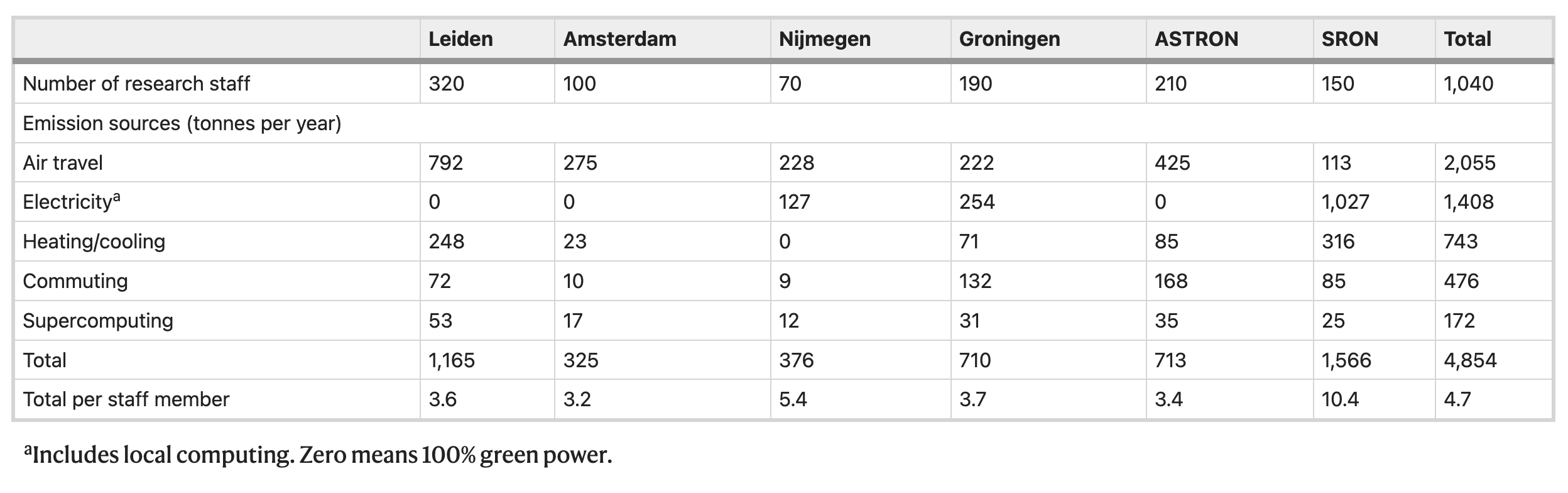
Several studies have been recently published, where the carbon footprint has been assessed in several institutes or countries. This is the case for research institutes in Australia (Stevens et al. 2020), the "Max Planck Institute for Astronomy" (MPIA) in Germany (Jahnke et al. 2020), the "MIT Kavli Institute for Astrophysics and Space Research" (MKI) in the US (Simcoe et al. 2022), the "Institut de Recherche en Astrophysique & Planetologie" (IRAP) in France (Martin et al. 2022), and the Netherlands institutes (which regroup the Leiden, Amsterdam, Groningen, and Nijmegen universities united in NOVA, ASTRON, and SRON; van der Tak et al. 2021). From the latter studies, it is clear that depending on the institute or the countries, there are a lot of differences in the emissions amount from one category to another (e.g. observatories, purchase, computing, travels...). However, only IRAP assessed all-astronomy-related GHG emissions (Martin et al. 2022a, b), in particular including the emissions linked to the use of the observatories and the purchase of goods and services, both not assessed for the Netherlands institutes, for example.
Therefore, assuming that the IRAP GHG emissions represent a good average of the annual carbon footprint, then the amount per employee working in astronomy is at least 30 tCO2eq, well beyond the recommended limit of 2.3tCO2eq we should aim for by 2030 to reach the Paris Agreement (e.g. Oxfam study 2021). As an institute, there are several actions we can take to try reducing our total carbon budget.
1. STRW travel survey report (2024)
As researchers, our travels to conferences, workshops and meetings account for the majority of the distance we travel (e.g. van der Tak et al. 2021, Blanchard et al. 2022 ), and hence, for the most part of our GHG emissions (Periyasamy et al. 2022; McClintic & Stashevsky 2023). We would like to remind also that only 1% of the world population flies(Gossling & Humpe 2020) and are responsible for half the total aviation emissions. We, as astronomers, are part of these 1% and are, therefore, part of the problem. A first natural and logical step we can take is thus to rethink our way to travel (by what means and how often for example).This is relatively easy and straightforward to do, and would already have a significant impact on the institute's total carbon budget.
The results of the travel survey we have circulated at the end of 2024 are available below.
2. The carbon footprint of astronomy research in the Netherlands
Abstract: Averting the imminent climate crisis requires large reductions in greenhouse gas emissions within this decade.
To provide a benchmark for reduction and to identify the main sources, we estimate the carbon footprint of astronomy research in the Netherlands over 2019.
Article link: Nature Astronomy, volume 5, pages1195–1198 (2021)